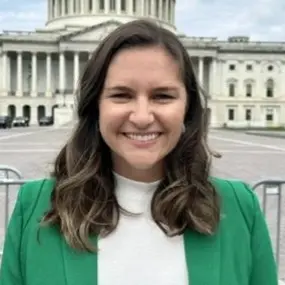
For National Child Health Day, Meghan Maroney of Voices for Healthy Kids, an American Heart Association initiative, highlights how nutrition during a child's first years of life can have lasting effects on their health and development. Maroney also spotlights the importance of parent and caregiver engagement in shaping policies and programs across states and territories.

 Spotify

 Apple Podcasts

 Amazon Music
Nutrition during the first years of life can have lasting effects on children's health and development. Meghan Maroney, senior advocacy advisor at Voices for Healthy Kids, an initiative of the American Heart Association, discusses the National Collaborative for Infants and Toddlers and its Nourish from the Start initiative, which works to strengthen nutrition security for infants, toddlers, and their caregivers. Maroney explains how WIC, SNAP, and the Child and Adult Care Food Program support families, and discusses opportunities for states to improve enrollment, reduce administrative barriers, and strengthen coordination across health, human services, childcare, and other systems. She also highlights the importance of engaging parents and caregivers in shaping policies and programs, and shares resources available to state and territorial health agencies working to improve nutrition from the prenatal period through age three.
Voices for Healthy Kids | American Heart Association
Funding & Collaboration Opportunities | ASTHO
CHIP Implementation Efforts at PHIG-Funded Local Health Departments | ASTHO
Measles Has Returned To America. We’re No Longer In Containment Mode | Forbes

JOHN SHEEHAN:
This is Public Health Review Morning Edition for Monday, October 5, 2026. I'm John Sheehan with news from the Association of State and Territorial Health Officials.
Nutrition during the first years of life can have lasting effects on children's health and development. Today, Meghan Maroney, senior advocacy advisor at Voices for Healthy Kids, an initiative of the American Heart Association, discusses the National Collaborative for Infants and Toddlers and its Nourish from the Start initiative, which works to strengthen nutrition security for infants, toddlers, and their caregivers.
Meghan Maroney, welcome to the show.
MEGHAN MARONEY:
Thank you so much for having me, John.
SHEEHAN:
So, Meghan, to start off, can you describe what the National Collaborative for Infants and toddlers is and how it works with Nourish from the start.
MARONEY:
Sure, the National Collaborative for Infants and Toddlers, or the NCIT, is a cross-sector coalition working to ensure that every infant and toddler can thrive. It's convened by Voices for Healthy Kids, which is an initiative of the American Heart Association. The NCIT brings together organizations and individual advocates from early childhood, health, nutrition, child care, family support, maternal and infant health, philanthropy, and other sectors around a shared goal of improving the outcomes for children during their earliest years of life. Nourish from the Start is NCIT's nutrition security initiative. It focuses specifically on ensuring that infants, toddlers, and their caregivers have access to the healthy foods, nutrition programs, and the supports that they need during the prenatal to three period. Through research, policy development, advocacy, and partnerships, Nourish from the Start helps elevate nutrition as a foundational building block for healthy development and lifelong well-being. The initiative is currently supporting advocates in 10 states. Those are Arkansas, Florida, Illinois, Kansas, Mississippi, North Carolina, Pennsylvania, South Dakota, Texas, and West Virginia, where advocates are working on policy campaigns that further the nourish from the start policy priorities. The initiative primarily focuses on three federal programs. The first one is the Special Supplemental Nutrition Assistance Program for Women, Infants, and Children, which is commonly known as the much shorter name WIC. The Supplemental Nutrition Assistance Program, known as SNAP or food stamps, and the Child and Adult Care Food Program, or CACFP.
SHEEHAN:
Gotcha. And just if you we could back up, why is early nutrition so important, and how do these programs help families get what they need to make sure that those kids get get that nutrition early?
MARONEY:
Early nutrition is so important. About 80% of a child's brain development occurs during the first 1000 days of life, and those first three years are a critical window for growth and learning. During this time, we have an opportunity to support kids' healthy brain development, their physical growth, immune function, and their social emotional development all through the food that they eat, and all of this lays the foundation for health, learning, and well being long into the future. All three of those programs provide either direct funds for families to purchase foods, or they provide the food for the children themselves. So, the Child and Adult Care Food Program: when children go to a daycare center or Head Start that is participating in the program, they'll receive foods that meet a predetermined meal pattern that is aimed at providing the nourishment that they need for that age group. SNAP provides direct financial assistance to families to purchase the food that they need, and WIC, similar to SNAP, provides funding for parents to purchase food, but it has a very specific meal pattern based on whether it's for a mother who is pregnant or postpartum, or if it's an infant or a toddler,
SHEEHAN:
Right. And so, speaking of those federal programs, those are advancing early child nutrition, but they have limits. Are there policy changes that would have a bigger impact?
MARONEY:
One of the most impactful steps that policymakers can take is ensuring that eligible families can access and stay enrolled in the programs like WIC and SNAP. At the federal level, the Nourish from the Start grantees are working on advocating to reverse the SNAP provisions of H.R. 1, also known as the One Big Beautiful Bill Act or OB3, that passed in 2025. OB3 made the largest federal cuts to SNAP in the program's history, and it fundamentally changes the way that SNAP is financed. According to the Center on Budget and Policy Priorities, more than 1.2 million children have lost SNAP benefits since July 2025, and unfortunately, that number is continuing to grow. For WIC, there is so much work that can be done to modernize enrollment and certification processes, expand remote service options, and recruit and retain eligible participants. Research shows that WIC reduces the risk of low birth weight and infant mortality. It increases access to healthcare, and it has positive maternal and child health outcomes, and it's a fantastic investment. For every $1 spent on WIC, researchers estimate between $1.77 and $3.13 in Medicaid savings. Despite its phenomenal outcomes, only about half of people eligible for WIC are enrolled, and when you dig deeper by age group, only about one in four eligible four-year-olds are still on the program. So, if Congress wanted to make an immediate impact on WIC, they'd fully fund the program for the upcoming fiscal year without scaling back any of the benefits, and permanently extend the pandemic-era flexibilities that allowed participants to be certified for the program remotely, as opposed to having to come in person to certify.
SHEEHAN:
And at the state level, are there partnerships that are essential to advancing childhood nutrition?
MARONEY:
Advancing this agenda will require strong cross-section collaboration among state health departments, the WIC agencies, Medicaid programs, public health divisions, human services agencies, food policy councils, and more. No single agency can address prenatal to three nutrition security alone, and meaningful progress is going to depend on coordinated efforts across all of these systems. And we've seen the power of these partnerships in communities across the country. For example, the Los Angeles County Food Policy Council, First 5 LA, and the Child Care Alliance of Los Angeles all worked together to ensure that the home-based childcare providers in the area were engaged in policy discussions around CACFP. They talked about things like challenges related to meal reimbursement rates, their out-of-pocket costs that they were facing, and the administrative burdens of running the program. In Mississippi, the Mississippi Early Learning Alliance has built a coalition that spans childcare, maternal and child health, and economic security advocates to advance policies that support nutrition security, but at the same time, not every recommendation in the Nourish from the Start policy agenda requires legislative action or broad coalition building. State and territorial health agencies often have the authority to implement important changes on their own, like streamlining reporting requirements, reducing some of those administrative burdens for the providers, improving program coordination, and more, and strengthening outreach to eligible families. Partnerships play a really critical role, but state health leaders also have a valuable opportunity to advance this work through improvements within their own agencies.
SHEEHAN:
And state agencies have access to Nourish from the Start's resources, such as a policy agenda, messaging guide, and toolkit.
MARONEY:
Yeah, so the Nourish from the Start resources are all available on our website, free to use. They're designed to help advocates translate the evidence into action. We have a policy agenda that provides a roadmap of robust federal and state policy recommendations. Some of which, as I mentioned before, can be implemented at the state agency level without legislation. We have a values-based messaging guide that helps agencies communicate about these issues in ways that resonate with diverse audiences by emphasizing these shared goals that we all have, like healthy babies, strong families, and thriving communities. And we also developed an advocacy toolkit that offers strategies, resources, and examples that partners can adapt within their own communities. So together, these tools help agencies build support for nutrition investments. It helps them engage their stakeholders more effectively and align efforts around a common vision for infant and toddler well-being.
SHEEHAN:
And can you talk more broadly about how agencies, state agencies, can involve parents and caregivers in, like, designing these programs, these policies, so that they can sort of tailor it to families' real experiences?
MARONEY:
Absolutely, families should certainly be engaged as active partners throughout the process with meaningful opportunities to shape the decisions and the outcomes. Parents and caregivers are experts in navigating the day-to-day realities of raising young kids in their own communities, and yet their perspectives can help identify barriers that policymakers and program administrators might otherwise miss. Agencies can engage families in a number of ways through advisory councils. There's focus groups, community listening sessions, compensated leadership opportunities, and ongoing feedback mechanisms. Something I want to really emphasize here is that the engagement should be meaningful, not just symbolic, and it should meet families where they are. Organizers should think about providing childcare or interpretation when needed, and having these engagements at times that parents can actually participate. Sometimes, meaning after work hours, compensate participants for their time, and show them how their feedback is incorporated into policy decisions. And also, importantly, the families engaged should be representative of the demographic makeup of the community that's going to be impacted by the program.
SHEEHAN:
Yeah, absolutely, and you know that number you cited at the beginning of the interview-the 80% of brain development happening in that first three years-it's a pretty stark number. Does that come as a surprise to people when they learn the importance of childhood nutrition?
MARONEY:
Absolutely. I think we often underestimate how important those first years are to long-term health and well-being. So, to make sure that babies have, you know, a chance to really thrive, we have to make sure that the children and their families have access to healthy, affordable food and the programs like WIC, SNAP, and CACFP that are evidence-based and supporting them in that journey.
SHEEHAN:
And for a state official or a health care provider, anyone that wants to take action now, what are some important first steps?
MARONEY:
Well, first, I would encourage every listener, no matter what your background is, to visit NCIT.org and sign up to become an advocate. By joining the network, you can stay informed about the prenatal-to-three policy issues. You can connect with advocacy opportunities in your community, communicate with policymakers directly, and engage with others who really care about this issue. If you're listening and you're a state or territorial health leader. I would encourage you to take a look at the Nourish from the Start policy agenda to see which of the policy recommendations your agency might already be implementing, or if there are ones that really speak to you and you might want to champion. Next, I would encourage everyone to check out whether they're individually eligible for these programs, and if so, I would encourage you to sign up. Or if you're working directly in communities, look closely at the information that's available to potentially eligible individuals. Is the local daycare operating CACFP? If not, is it because of barriers that can be addressed by a state agency? Is information about SNAP and WIC readily available through programming offered by the community? Every individual at every level has a role in raising awareness of these programs and helping families access the support that they need. Which brings me to my last recommendation. As an advocate, I will say: speak up, share your experiences, participate in community conversations, and support policies that help ensure all families can access healthy food. Personal stories and local perspectives are such powerful tools for driving policy change and improving outcomes for our communities.
SHEEHAN:
So, Meghan, as an advocate, why is this work so important to you?
MARONEY:
This is such an important topic for me because I can see what a difference nutrition makes for myself and my family. I'm a mom of two little kids, and it's hard to get your kids to eat healthfully and to have the resources and access to find those foods. So I just am very passionate about making sure that we make it as straightforward as possible for people to have the access to the food that they need to feed their families.
SHEEHAN:
Well, Meghan Maroney, thanks so much.
MARONEY:
Thank you.
SHEEHAN:
Meghan Maroney is a senior advocacy advisor at Voices for Healthy Kids, an initiative of the American Heart Association.
Apply to the Public Health Story Lab. Public health professionals and community members are invited to apply for a storytelling coaching program running from October to December, ending with a live storytelling event the first week of December 2026. Selected participants will work with a professional storytelling coach to develop a meaningful public health experience into a clear, compelling story that they can use in their work and share with a broader audience. Find more at the link in the show notes.
Community health improvement plans, or CHIPs, help public health agencies and community partners coordinate action around shared priorities. CHIPs create a framework for collective action and measurable progress toward improving community health by bringing together organizations from multiple sectors around shared priorities. Read more about CHIP implementation efforts at PHIG-funded local health departments at the link in the show notes.
This has been Public Health Review Morning Edition. I'm John Sheehan for the Association of State and Territorial Health Officials.