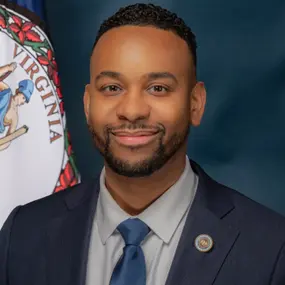
Cameron Webb, ASTHO member and commissioner of the Virginia Department of Health, highlights the agency's approach to building trust, strengthening the public health workforce, and implementing a new electronic health record system.

 Spotify

 Apple Podcasts

 Amazon Music
Building trust, strengthening the public health workforce, and modernizing the Virginia Department of Health are among the priorities for Cameron Webb, commissioner of the Virginia Department of Health and an ASTHO member. Webb discusses how his background as a physician, health policy leader, community health worker, and federal COVID-19 response official has shaped his approach to leading a state health department. He outlines efforts to improve agency operations, communicate more effectively with communities, embed equity in public health work, and rebuild trust following the COVID-19 pandemic. Webb also highlights initiatives including nursing home oversight, hepatitis C elimination, a new electronic health record system, rural health transformation, community health worker programs, predictive analytics and AI, and efforts to address maternal mortality.
Hurricane Response and Recovery | ASTHO

JOHN SHEEHAN:
This is Public Health Review Morning Edition for Thursday, October 1, 2026. I'm John Sheehan with news from the Association of State and Territorial Health Officials.
Building trust, strengthening the public health workforce, and modernizing the Virginia Department of Health are among the priorities for Cameron Webb, commissioner of the Virginia Department of Health and an ASTHO member. Today, Webb discusses how his background as a physician, health policy leader, community health worker, and federal COVID-19 response official has shaped his approach to leading a state health department. He outlines efforts to improve agency operations, communicate more effectively with communities, embed equity in public health work, and rebuild trust following the COVID-19 pandemic.
Dr. Cameron Webb, welcome to the show.
CAMERON WEBB:
And thanks so much for having me.
SHEEHAN:
So, Dr. Webb, you've been on the job since January. How do you feel that your career sort of set you up to this point, and what are some of your big priorities?
WEBB:
Yeah, you know, I talk a lot about how, as a leader coming into roles like this, you have an identity, right? And my core identity is that I'm a physician. That's kind of the role I've occupied in society. And in this role, there's a lot of similarity in the sense that, you know, as an internist, I've historically walked into rooms, asked people where it hurts, listen for an answer, and work towards solutions. And I think that's what this job really is about. So I think that's a big part of it. The other key lesson that I learned from, you know, my clinical practice is we often say you can't treat what you don't see, right? And I think that for me, really being hungry for data and for information to understand the challenges facing folks across the Commonwealth, it's been so important. So I think that as a physician, there's a lot that's prepared me for this role. But you know that that's not my only prior role. You know, I've previously worked in health policy, and that's kind of where my law degree comes in. And you know, I work at that intersection of health and social justice, and that's something I'm passionate about. I've worked on social justice initiatives more broadly, and I think that there's a lot of intersection between social justice and public health, and so, I draw on those experiences liberally. You know, of course, I worked in the Biden administration helping to lead the COVID response. So, that's a large-scale public health emergency response, and I think I leverage that skill set in kind of being nimble in public health emergency settings. I think which is helpful, and then finally, I'd say that, you know, one of my first roles was that I was a community health worker when I was in residency in New York, and so, you know, really having that on-the-ground perspective as being somebody who's, you know, in the community and, you know, deeply embedded and connected with the community, helping to drive, you know, health forward. You know, that's something that I draw on every day in this role, and so far, I think those roles feel like they prepared me well. Obviously, I have a really strong team around me, and so they kind of keep things rolling. And so, when you ask kind of what my priorities are, the first priority is operational excellence, right? It's making sure that we're investing internally and making this department the best that it can be. After that, it's something I think is common really across the country, which is restoring trust in public health, and you know we do that by communicating early and often and candidly with authenticity. You know, really being present and communicating in communities long before there's a crisis, and that's going to help you know what you do communicate come across more authentically in a tough moment. And then finally, I just say embedding equity in everything we do. I say centering equity, but that's making sure every community feels, you know, seen, heard, viewed, and valued, and that's grounded in data. It's grounded in lived experience, but it's making sure that we're able to get folks what they need. And so those have been the main priorities that have animated our work, and so far, so good.
SHEEHAN:
Wow, yeah, that's a wide range of experiences. Sort of, it seems like, from personal interactions as a physician, all the way through thinking at the community level to thinking at the large policy level, the overarching policy level. How do those experiences, if you could sort of triangulate, how that's informed your approach as a leader?
WEBB:
Well, I think that you're a systems thinker first, right? So I think that in so many ways, you're understanding that the experiences people have aren't isolated necessarily, but they work within the context of structures and systems, and so I think that helps. You know, we understand our patients from a clinical perspective in a community context, and similarly when we do public health work, and we try to, you know, design. One of the first things I always say is that, you know, yes, all politics is local, but all public health truly is local, right? Like, the experiences have to be deeply tailored to the needs and concerns of individuals and in individual communities, and so I think that that's one of the ways is, kind of, thinking as a systems leader. I've seen that both in my prior policy work and in my clinical work. I think that, you know, kind of uniquely for me, I've worked in a range of different political environments. You know, I worked for President Obama on his My Brother's Keeper initiative, and then I worked for President Trump as a White House fellow and worked on on drug pricing and and some other domestic policy work in 2016 and then or 2017 really and then most recently I worked for President Biden you know these are all very different political environments but what I learned from it is that there's a lot of commonality in kind of the the goal of meeting the needs of communities, your your language may be different, but you can actually connect with a range of folks, you know, ideologically on really centering on making sure that communities have what they need to be successful, making sure that nobody's left behind, and and even even as I describe equity, right? I framed it. I was like, equity is so critical to me. And you may feel like that doesn't fit under a certain political paradigm. I can tell you that if I describe it as access to opportunity, or if I talk about the rural context and rural health equity being important, making sure that they're not getting left behind relative to other environments, suddenly it works in a political context. So I think learning how to engage people, regardless of where they are, who they are, and kind of what they feel ideologically, I think that's a huge opportunity in public health. And my prior experiences have prepared me for that as well.
SHEEHAN:
Absolutely, and are there any initiatives in the department that you're most excited about?
WEBB:
I mean, you know, like I said, there's a lot of breadth to what we do here at the Virginia Department of Health, so there's a lot of work, and I'll say I'm very excited about a huge range of the work that we're doing. You know, I would say I talked about those three kind of pillars of what we're aiming to do: the whole operational excellence, trust building, and having an equity lens; those are really critical. And I would say those animate a lot of our individual programs and initiatives. There's kind of a slightly different combination of initiatives that are top of mind anytime somebody asks me this question. So I'll say, kind of at its core, you know, there are things we're aiming to do. We want to support Virginia seniors. We're doing a lot of work in nursing home oversight, and that's something I'm really excited about because it's really helping us to, you know, meet folks at a point in the life course in public health that's often forgotten about or left behind. Right? We focus so much on prevention, but kind of meeting the health needs of aging populations, I think, is critical. So I think our work around nursing homes has been really exciting. I'm really excited about some of the work we're doing to try to advance the elimination of hepatitis C. You know, I've, you know, have personal interest in it from folks I know who've been deeply affected by it. But more importantly, we have all the tools in this moment to cure everybody who has hepatitis C. So let's go out and do it. So that's exciting. Apropos of doing this podcast, right? I love communicating, and I think that really strengthening our communications space as an agency and in supporting our really strong communications team, and getting messages out far and wide and in a way that connects with audiences. That's exciting work to me. As an agency, I'll tell you we're innovating a fair bit. So we're rolling out an electronic health record for VDH for the first time. So you know, some folks would say, "Hey, that's late, you know. But I would say in public health, it's kind of unique to have an EHR system that's designed for public health purposes in our local health districts, and so we're excited about that model and some of the work we're doing there to better coordinate care and help people access health information. So it's kind of cool that we've kind of built this EHR system from the ground up, and then, you know, we're like a lot of states or all states, we're doing work in the rural health transformation space. So some really cool, innovative opportunities there, and VDH is leading on some of that. I'll close with just probably two or three more that are really important to me. One is, you know, building out some of our equity portfolio, and in particular, thinking about what those priorities need to be. So we have an advisory council on health disparities and health equity, and so deploying them over the next year to come up with a strong series of recommendations, I'm really excited about that collaboration. Working with Medicaid about, you know, getting more community health workers here in Virginia is top of mind. We're doing some work thinking about predictive analytics and AI in public health, and I think that's one of the cool things that I think is top of mind. And then finally, I'll just say doing some collaboration with kind of the Department of Behavioral Health Services, DBHS, and I think that's really cool work we've done around maternal mortality, particularly around postpartum depression, and I'm excited about that. You know, my younger sister just had a baby a couple weeks back, and just thinking about how exciting and challenging a time that is, I think it's cool to be able to, you know, help oversee a large initiative and then see on the ground just how in real time it's it's relevant to the people who you love, and so that's been really fun. So it's just a flavor. Like I said, if you ask me that question two days from now, you'd get a different combination, but I love the breadth of our work, so I'm excited about so much.
SHEEHAN:
Absolutely. Another challenge, certainly not unique to Virginia's Department of Health, is workforce retention and recruitment. What are you doing in Virginia?
WEBB:
Yeah, you know, the public health workforce has been through a lot in recent years, and yeah, there was a gentleman whom I got the chance to know when I worked in the Obama administration, and his name is Charlie Bolden. He's actually an astronaut, and he led NASA at the time, and really underwent this transformation of that agency went from, you know, a middling agency workforce-wise to being the best place to work in all of the federal government, and what always stuck with me is that, you know, through intention and the way you show up for people you can really transform a place into being a destination to work, and that's our goal here at VDH. So we're in that process, really trying to make this the best place to work in all of Virginia state government, and I think we start that by listening to the folks who work here, really understanding the things that get them excited to come into work. And I mean, I hate to say it, but it's not the salary. Like, what gets them excited is it's really about the heart in the work that they do, and connecting with that and making it easier for them to do those things, and so I would say that that transformation effort has been a key part of it. You know, I think we're we're doing a lot of work. I would say, kind of in the traditional engagement initiatives space, we're looking at kind of daily work, the administrative processes, and operational challenges that impact the employee experience. So those are things that I'd say make a huge difference. More broadly, you know, career ladders are one thing that we've been thinking about, right? So in public health, you know, having a space to grow into roles and eventually into leadership, I think, is important. And I think similarly, you know, our agency it's beautifully diverse, and I would love to continue to see that diversity reflected across the leadership levels of this organization as well. So, how do we, you know, grow and develop leaders who look like the Commonwealth of Virginia? I think it is also really important for us to see and do. I mentioned community health workers. That's kind of a burgeoning part of the public health workforce, and so that's one area that we're leaning in and trying to do a little bit more. We've got some loan repayment programs that we're helping to lead that I think are really important. And so here at VDH, we do have a dedicated team that's focused on culture, engagement, and development. I think that's a huge part of it. It is having people where that's how they spend their every day, to make sure that people are having a good experience, and so you know those are parts of it, but I think more than anything it's just continuing to show up, listen, be responsive, have humility, and be willing to iterate on making this the best place to work.
SHEEHAN:
And finally, looking to the horizon, are there any challenges, perhaps unique to Virginia, or opportunities that you're kind of watching out for?
WEBB:
You know, I think I'll start with opportunities. You know, we've got, and of course I'm biased, but we've got an amazing governor who's passionate about health and the safety of Virginians, and I think that there's alignment there, and she really wants to see us innovate and create and find efficiencies and, you know, do great public health work for people in Virginia, and so excited about what that does. But you know, we also have a secretary of health and human resources who similarly is aligned. So there's this connection between the leadership chain that creates an opportunity and a window. We've got a really strong general assembly, and they're eager to do work in the health space. You know, the governors talked a lot about kind of an affordability agenda, and we've been talking a lot about prevention as affordability, right? And I think that that's sticking, that's resonating, and I think there's a huge opportunity there, and that's important because it kind of dovetails with one of the challenges, which is that, you know, federal funding is more precarious than probably at any point in recent history. Just the approach to managing grants and how those are the certainty that people have around federal grant funding is just not what it was, and so I think for us being able to continue to deliver services and resources and supports to communities against that backdrop, I think it's going to require a lot of state engagement and state investment. So that's one part of it. I would say, in terms of challenges, you know, we have to find a way to turn the page from the trust moment of the last, you know, seven or eight years, where folks really were contending with understanding public health in one way before COVID-19, and in another way during it, and now kind of evolving to how are we experiencing it afterward, and really just reestablishing ourselves as, you know, folks from your community in your community, whose mission and focus and dedication is really based on your health and your well-being. And I think that we're going to do that. I think we're going to be able to lean into that messaging, that branding, and that identity. I think that's a huge opportunity. But again, the challenge is just there's a, you know, political dynamic to everything in society, and certainly public health's not immune to that. And so, making sure that we're showing up in a way that people know is authentic, is genuine, is sincere, you know, despite the fact that so often people see it as being political. So those are some of the moments that I see and some of the challenges, but um, but more than that, I think I'm blessed. We've got a great team, and that's, you know, the 3,200-plus people who work at VDH. You know, really excited about how they're all able to show up for communities. I think it's an exciting moment.
SHEEHAN:
Well, Dr. Cameron Webb, thanks so much.
WEBB:
Thanks for having me.
SHEEHAN:
Cameron Webb is commissioner of the Virginia Department of Health and an ASTHO member.
In 2023 and 2024, ASTHO received funding from CDC's National Center for Environmental Health and Agency for Toxic Substances and Disease Registry to help state and territorial health agencies in North Carolina, South Carolina, Florida, and Puerto Rico build environmental health capacity in response to hurricanes Ian and Fiona. In addition to providing support to the four jurisdictions directly, ASTHO convened a monthly community of practice, which provided an opportunity for them to share project updates, request support on topics related to environmental health preparedness, and share best practices for addressing environmental health threats following hurricanes. Learn more at the link in the show notes.
The Public Health Infrastructure Grant is driving progress in strengthening public health systems nationwide. Want to stay in the loop? The PHIG national partners' Connections newsletter is your one-stop source for funding engagement opportunities, program updates and success stories, events, training and webinars, tools, resources, and more. Subscribe now and stay connected to the national conversation shaping the future of public health. The link is in the show notes.
This has been Public Health Review Morning Edition. I'm John Sheehan for the Association of State and territorial health officials.