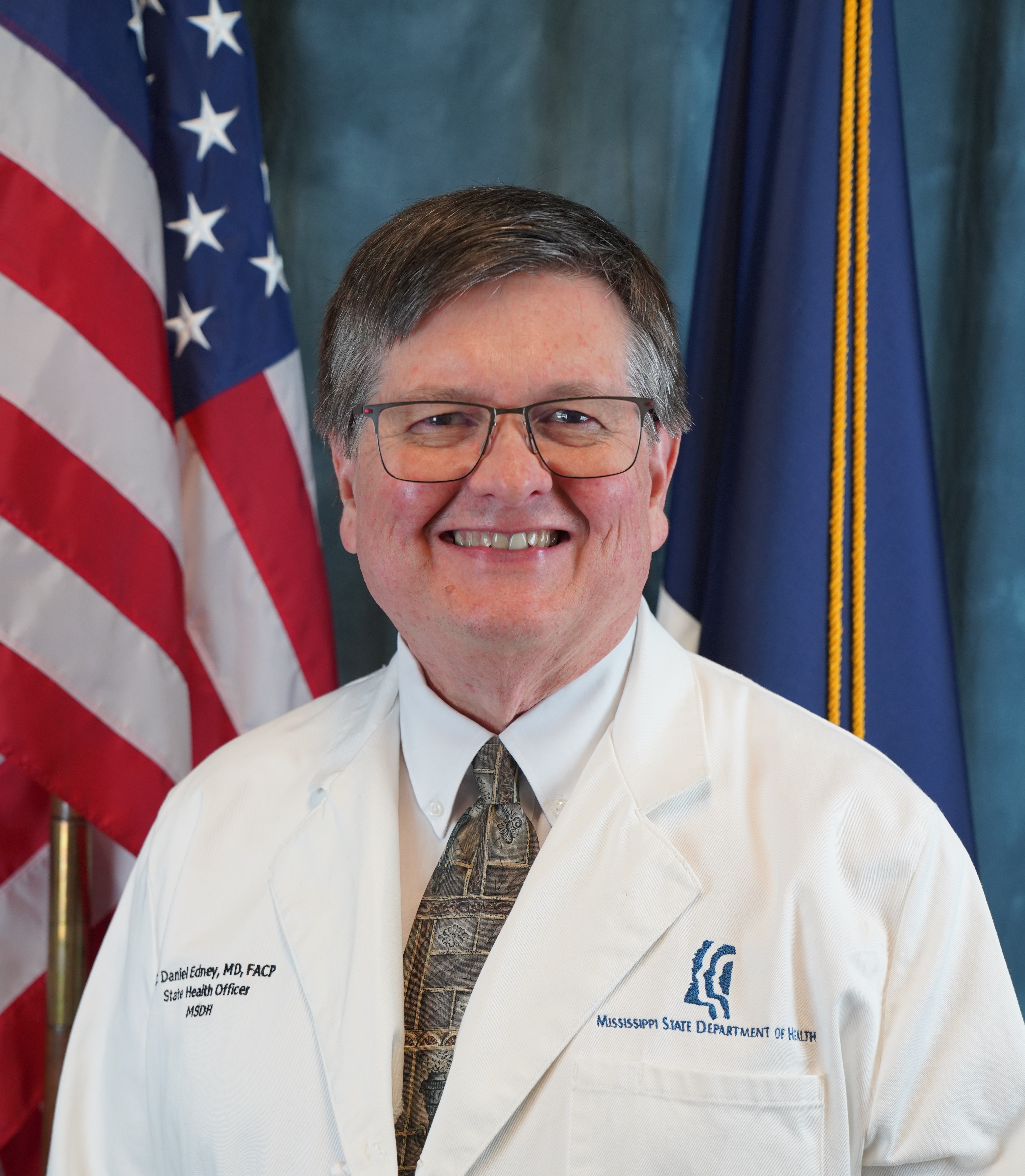
Daniel Edney, ASTHO's new president and Mississippi's state health officer, discusses topics that health officials raised during ASTHO’s recent Fall Leadership Forum. From flexible funding to measles and vaccine misinformation, he explores how states are diversifying resources and communicating with their communities.

 Spotify

 Apple Podcasts

 Amazon Music
State and territorial health officials are navigating renewed measles outbreaks, uncertainty around federal funding, and questions about how to sustain essential public health services. In this episode, Daniel Edney, new ASTHO president and Mississippi's state health officer, discusses several hot topics health officials raised during ASTHO’s recent Fall Leadership Forum. Topics include the importance of flexible funding through the Public Health Infrastructure Grant (PHIG), strategies for responding to measles and addressing vaccine misinformation, and preparing for potential funding reductions. The conversation also explores how states are diversifying resources, communicating with communities, and learning from one another.
ASTHO Falls Prevention Virtual Community of Practice
ASTHO Brain Health and Caregiving Virtual Learning Community

JOHN SHEEHAN:
This is Public Health Review Morning Edition for Thursday, October 29, 2026. I'm John Sheehan with news from the Association of State and Territorial Health Officials.
Health officials are confronting renewed measles outbreaks, uncertainty around public health funding, and the challenge of sustaining essential services. Today, Dr. Daniel Edney, new ASTHO president and Mississippi's state health officer, discusses three hot topics facing public health leaders: flexible funding, measles response, and preparing for funding uncertainty.
DANIEL EDNEY:
Every year, we have a list of important topics to state health officers. We have a conversation, usually an hour, hour and a half, on those topics, and we allow the shows to rank-order those. And the top three hot topics this year had to do with PHIG, had to do with measles response, and then how to deal with uncertainty of funding streams. So really interesting topics. The general conversation with PHIG was how important it is. All of us are rebuilding infrastructure from pandemic response using PHIG, and you know, a big question I had is what in the world would we have done without it had we not been given that block grant funding? And it's also that we all recognize the importance of the model of providing it more in a block grant fashion, giving us flexibility, allowing us to pivot as we learn more, as we deploy resources and in different areas, and how we could easily translate that into the model for public health funding instead of having 50 different funding streams, many of them very prescriptive, you know, really looking at that flexibility model that PHIG or other things like the Title V MCH block grant, you know, really provide for us. It was interesting; that was a conversation with Dr. Schwartz, you know, she was supportive of flexible funding, so we were all listening to that intently, and then our conversations mostly were driven around unified messaging to the importance of PHIG and the need to continue it in some form or fashion moving forward after 2027.
SHEEHAN:
What did you discuss related to measles?
EDNEY:
Well, a lot of it had to do with the frustration of why we're even having to respond to measles after we had achieved elimination status. But we are where we are, so dealing with that. A lot of it had to do with messaging to the movable middle and those, you know, those families who are seeking answers? Who are confused by misinformation? And how we, as public health professionals, you know, can communicate clearly in a non-judgmental fashion? We talked about the heartburn that we face with states that have not dealt with measles in a very, very, very long time, and providers like myself who've never seen measles. I'm 65 years old, and we've not had measles in Mississippi since I started practice. So doctors like me, you have to be a generation older than myself to have seen measles in Mississippi. So for my generation and younger, it hadn't been on the differential, but it has to be now. So educating providers to think about measles and, you know, identify it quickly, and then states like Mississippi, you know, having to, you know, build back up our muscle memory on measles response, which we've not done in 35 years, and you know, work out the atrophy of, you know, response for things like measles, you know, because we just haven't done it in a long time. And then also a big question on funding. You know, we've not had to invest in dealing with measles outbreaks in 35 years. So where's that funding going to come from? So, you know, all of us are having the same levels of concerns and learning from each other. I thought that was a great point. How we've all been connecting with our peers and watching, you know, learning from the Texas outbreak and then the South Carolina outbreak, the Utah outbreak, and now, you know, Dr. Deb Bogan doing a great job leading the Pennsylvania response and lessons learned with each one of those because they're lessons that were forgotten, and now we're having to relearn, and we're learning from each other. And then, you know, I'm watching responses from states more like myself that have extremely high vaccination rates that are starting to see, you know, some return of measles, and you know, how do you respond in a red state versus a blue state? The science is the same, but the politics may be very different.
SHEEHAN:
And what should state health officials know about funding?
EDNEY:
We're all in the same place of just such uncertainty related to funding. Four years ago, my concern with uncertainty related more to state and county funding, and then two years ago, all the cuts started hitting us from the federal level. So the DOGE rescissions and then the proposed HHS budget cuts that thankfully have not come to fruition yet, but we still worry. I had to assume that those proposed budgets could come, you know, to pass, and then we're looking at a 30% reduction in our federal funds, which could be catastrophic for many of us. So, you know, we've been working in Mississippi to prepare for that, knowing you know that it just is so so unhealthy for any funding model to be heavily dependent on one funding stream. So we've been working to diversify our funding streams. Many states are doing likewise, generating revenue to the best of our ability. Obviously, cutting overhead, evaluating programs as to sustainability and how mission-critical these programs are, and then when we're forced into decisions to cut, doing it thoughtfully, and you know, when we in public health are forced to cut, I mean we'll be doing it strategically. But it was really interesting listening to other state health officials looking for the same challenges that I am in Mississippi and different approaches, and a lot of conversation about public-private partnerships, and then the importance of making sure our state appropriators know the importance of public health, the relevance of public health, the fact that we're a core function of government, and just staying on message. You know we're not a luxury in the state's budget. You know we're a necessity, and just make sure we advocate for ourselves in an effective manner.
SHEEHAN:
And what else did you discuss with attendees? And what else would you like to share that health officials should know about?
EDNEY:
This is a convening of my colleagues and peers that I don't get anywhere else, and as a state health official, being the chief public health official in Mississippi, there's no one else I can talk to. I mean, even my executive leadership doesn't understand the same challenges, stresses, and pressures that are on us as the chief public health officials around the country. But my colleagues do, and so you know, ASTHO is where I cultivated these relationships so that when I need to pick up the phone and call my friends in other states, that we know each other and that we take each other's calls immediately because we know it's important, and then to convene like we are today, and you know to hear from Dr. Schwartz, who's an important leader in our lives as CDC director, but then to listen to each other as we talk about common challenges, and then my colleagues in blue states and red states and purple states, and we all learn from each other. And I like to say our politics may be very different at the state level, but the public health science is exactly the same. And when it comes to policy, we're all united, and that's very encouraging to me.
SHEEHAN:
Dr. Daniel Edney is the new ASTHO president and Mississippi's state health officer.
ASTHO is accepting applications for the 2027 Falls Prevention Virtual Community of Practice. This cohort-based learning experience will provide a platform for participating teams to exchange insights, develop action plans, refine implementation approaches, and strengthen planning for expanding falls prevention through community clinical linkages. COP participants will engage in a series of virtual sessions to learn from fellow teams and experts, and receive technical assistance to implement study-based strategies for preventing falls among older adults. Learn more at the link in the show notes.
The Brain Health and Caregiving (BHC) Learning Community is a cohort-based learning experience that will support state teams in learning about and implementing promising policies, models, and strategies for advancing brain health and caregiving. BHC Learning Community participants will engage in a series of virtual learning sessions and receive technical assistance from ASTHO to help identify and execute sustainable actions to support brain health and caregiving in their state. Find out more in the show notes.
This has been Public Health Review Morning Edition. I'm John Sheehan for the Association of State and Territorial Health Officials.