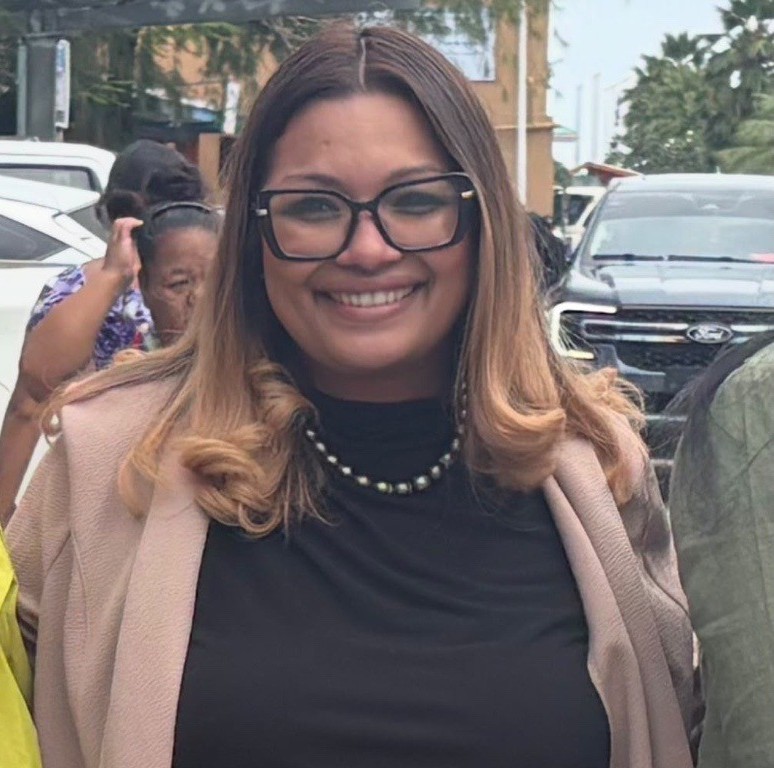
On today's installment of the PHIG Impact Report, Francyne Wase-Jacklick, ASTHO member and secretary of Health and Human Services for the Republic of the Marshall Islands, discusses how the agency incorporated key performance indicators into its strategic plan to strengthen how public health leaders measure progress, use data, and make decisions.

 Spotify

 Apple Podcasts

 Amazon Music
The Republic of the Marshall Islands is strengthening its health system by improving how leaders measure progress, use data, and make decisions. In this episode of the PHIG Impact Report, Francyne Wase-Jacklick, an ASTHO member and secretary of Health and Human Services for the Republic of the Marshall Islands, discusses how the ministry incorporated key performance indicators into its 2024-2030 strategic plan and how flexible funding is helping build long-term institutional capacity. She shares early results, and explains how partnerships with schools and other community organizations are helping improve health outcomes. Wase-Jacklick also discusses the importance of sustaining these efforts beyond the grant period by investing in local expertise, accountability, and a culture of continuous improvement.
This work is supported by funds made available from the Centers for Disease Control and Prevention (CDC) of the U.S. Department of Health and Human Services (HHS), National Center for STLT Public Health Infrastructure and Workforce, through OE22-2203: Strengthening U.S. Public Health Infrastructure, Workforce, and Data Systems grant. The contents are those of the author(s) and do not necessarily represent the official views of, nor an endorsement, by CDC/HHS, or the U.S. Government.
Public Health Infrastructure Grant: Resources & Impact - PHIG

JOHN SHEEHAN:
This is Public Health Review Morning Edition for Tuesday, October 27, 2026. I'm John Sheehan with news from the Association of State and Territorial Health Officials.
The Republic of the Marshall Islands is strengthening its health system by improving how leaders measure progress, use data, and make decisions. On today's PHIG Impact Report, Francyne Wase-Jacklick, secretary of Health and Human Services for the Republic of the Marshall Islands, discusses how the ministry incorporated key performance indicators into its 2024-2030 strategic plan and how flexible funding is helping build long-term institutional capacity.
Francyne Wase-Jacklick, welcome to the show.
FRANCYNE WASE-JACKLICK:
Thank you, John, for having me today.
SHEEHAN:
So, FrancYne, the RMI Ministry of Health recently overhauled its strategic planning process, and a big part of that was implementing key performance indicators (KPIs). What was that like? What are the KPIs, and what does it mean to meet a KPI?
WASE-JACKLICK:
Thanks, John. The KPI process really grew out of a broader effort to strengthen how we manage the health system. So, our Ministry of Health and Human Services strategic plan, or MSP 2024-2030, was developed as part of our national planning process and aligned with the RMI National Strategic Plan, as well as the President's Agenda 2030, so it was not developed by a small group in isolation. We went through a ministry-wide consultation and validation process involving our leaders, bureaus, programs, as well as our partners. So we also brought people together to look honestly at where we are, what was working, where the gaps were, and what we needed to change. So we reviewed at the existing plans, laws, regulations, policies, as well as service delivery realities, and those discussions were then consolidated by and reviewed by leadership, taken through broader validation, and ultimately finalized and signed by the minister and secretary. So, the plan was never intended to sit on a shelf. This is now our third year of formally monitoring the NSP annually with management and leadership, and we continue to treat it as a dynamic management instrument. So, for the KPIs, we ask some very basic questions: Is this important to our national priorities? Can we measure it reliably? Do we have reasonably available data? And will knowing this information actually help us make a better decision? And I always remind our teams that a KPI is a signal; it is not a score. If an indicator is not where we want it to be, the first question, it always comes to mind is: who failed? Because it's also on a dashboard color, you know, the streetlight color- red, green, yellow- because it's supposed to, like prompt you, but it is: why is the intervention working? Is the target realistic? Do we have the workforce, and are the supplies available? Are the finances adequate? Do we have? Is the data reliable? As well as you know, our geographical challenges affecting the axis, and are the external factors have we have we done enough to take account for it? Then the KPI becomes useful because it helps leadership decide what needs to change, like the intervention, the resources, the process, or the target, or sometimes our understanding of the problem. So the plan tells us where we want to go. The KPI tells us whether we are moving, and management has to decide what to do with that information.
SHEEHAN:
Very well said, and I agree. KPIs can be one of those things where it does. You're right. It feels like a scorecard when, in reality, it's a measurement. It's saying, you know, was our assumption correct? And if so, how close are we to it? Ideally, how does PHIG funding play into how you've implemented this KPI system?
WASE-JACKLICK:
Yes, it was important because having a strategy is one thing, but turning the strategy into consistent management practice is another. We already had the strategic direction, so when the PHIG opportunity came to us, PHIG did not create our strategy. What it gave us was an opportunity to strengthen the infrastructure around implementation: our people or the staff, planning, performance management, the use of the data, coordination, and the institutional capacity. That distinction is important to me because we did not want to create a PHIG system sitting beside the Ministry. We wanted to strengthen the Ministry of Health system we already owned. As a small island health system, our priorities do not arrive in need categories. We are managing NCDs, NCH, communicable diseases, workforce constraints, neighboring access, daily ongoing, you know, challenges, referrals, as well as financial pressures. So often at the same time, so flexible support matters because it allows us to strengthen the underlying capacity that helps us to respond to all of those priorities, and for me, faith is most valuable when it is it builds us, it helps us build the muscle of the institution. So that planning, that measurement, decision-making, and accountability become part of how MOHHS or the ministry operates, rather than something we do only because a grant requires it.
SHEEHAN:
Yeah. Have you noticed any early benefits or wins from flexing that muscle?
WASE-JACKLICK:
Yeah, I think one of the biggest benefits is that we are seeing management and leadership translate information into different approaches. So the numbers do not improve simply because we're putting them on a dashboard. They improve because when leadership looks at that information and asks what is behind it, it changes the approach, the follow-throughs, and holds the system accountable for the next step. A good example is immunization. We saw immunization coverage increase from 47% to 73% in 2225, and that improvement reflects changes in how we approach the work, to have stronger management and leadership attention and better follow-through with the teams responsible for implementation. We also strengthen our partnership with the school system, recognizing that schools are also an important connection for children and families, and also rely rather than relying only on the health system to reach people. We have also been working more closely with the schools to help identify students who are in default or need immunizations and support families in getting the vaccines on time. And to me, I think that kind of partnership matters because public health outcomes are not produced by the Ministry of Health alone. They require us to work across government with the community as well. We have also seen progress in the trimester antenatal care, which increased from 34% to 45%. It might not be significant, but it's increasing. It's not decreasing, and we continue to strengthen the clinical governance and other systems that support quality and accountability. We have also advanced our NCD strategic and surveillance planning, and we're continuing to build services such as dialysis, so people can receive more care closer to home. What I think is an outcome that is harder to measure and perhaps even more important, and that leadership conversation is changing. We are increasingly asking not only did we do the activity, but we are asking what changed, and why did it change? What did we learn, and what do we need to do differently? And that is the culture of performance management we are trying to build here.
SHEEHAN:
Absolutely. Do you have plans to grow and sustain this process?
WASE-JACKLICK:
The biggest issue is institutionalization. We cannot build something that depends on one person, one champion, and one grant. We have to build it in a way that the ministry works into planning, budgeting, workforce management, program reviews, leadership meetings, and ultimately, the way we hold ourselves accountable, that connects strongly to our philosophy of grow your own and keep your own. We have to continue developing our own people and strengthening internal technical capacity so that the knowledge and discipline remain inside the ministry. And we also have to recognize that meaningful change naturally brings questions. Some people will either embrace it immediately. Others will need to- they'll need the time to understand what it means for their work, whether they have the resources and support to succeed, and how success will be measured. I do not necessarily see that as resistance. I see it as part of change management, and our responsibility as leaders is to listen, explain the why, provide that support, and make expectations clear and remain consistent. We can. Have grace and accountability in the same room, and we can be compassionate toward people doing the work without lowering the standard for the work itself. Because, as you know, John, you know, change is inevitable. Our job as leaders is to help people move through it and keep moving.
SHEEHAN:
Do you have a vision of what success would look like, and sort of a Part B? Like, is there really such a thing as like a successful completion? It seems like it's sort of a process.
WASE-JACKLICK:
It's a process, and for me, ultimately, this work comes back to serviceability. I have always believed that we have a high call to serve, and leadership to me is not simply about holding a position or managing a program. It's really asking ourselves: how useful are we to the people we are here to serve? What are we giving back, and what are we leaving the system stronger than we found it, and that belief comes from, you know, I've always held to my own culture, and I hold several of them, had some Marshallese wisdom when I grew up. One of them is we say 'ugal pagayo,' turning the tide, giving back what has been given to you. I carry that with me because I believe we have a responsibility to take what we have been entrusted with: our knowledge, our opportunities, our resources, and our leadership, and turn it back towards our people. There is another one that I like to use, and it helps me to bring in certainly, "Jouj eo mour eo," real kindness begets life, and for us, 'jouj' is more than simply being kind. It is about reciprocity. It is about caring responsibility for another, protecting our families and our communities, and understanding that what we do for others ultimately sustains all of us, and I think those values are deeply connected to public health, because behind every percentage is a person, and behind every indicator is a family. I have three kids, you know, and I always think of, you know, wherever the policy is, you know, someone is there trusting us to do our job well. And reforms will never be perfect, linear. There will be financial pressures. There will always come challenges. There will be health emergencies, outbreaks, or moments when people embrace change and moments when people question it; that is part of leadership, and our responsibility is to lead through it with the evidence given to you in front of you and with accountability. And for me, that is what PHIG represents at its best. Not simply because it's a project, but its helping us build that capacity, that discipline, and the systems to serve better, and to keep improving after the funding is gone. We may be a small country or a small island, but our responsibility to our people is not small. So we keep moving one reform at a time, one community, one person at a time, and I think it's so key for us to be working in unison and working together. There's a saying that it takes a village, and that is a heart of serviceability. We may not be able to change everything at once, but every day we have an opportunity to make the system a little more useful and a little bit more responsive in a way that is more worthy of the trust where the people place on us.
SHEEHAN:
And lastly, Francyne, could you talk a little bit about, and you just alluded to this, the importance of that sustained funding? And as you mentioned, you're going to proceed either way. But when there is that funding, when there is that investment, it really helps.
WASE-JACKLICK:
Yes, thanks, John. The sustained, flexible funding would allow the RMI to continue strengthening the foundation of the health system, not simply fund another categorical activity that matters enormously for us because our needs are interconnected. The flexible funding allows us to respond to those realities while staying anchored to our national priorities. But sustainability is the key word, and I would not want faith to create dependency. I would want it to help us build capacity that remains when the funding cycle ends, and the ministry has to keep using it if we can continue shrinking. Our people, our systems, our practices, and our ability to turn evidence into action- then the benefit goes beyond one period, a grand period. It becomes part of the institution, and ultimately, that means a stronger and more responsive health system for the communities we serve.
SHEEHAN:
Well, Francyne Wase-Jacklick, thanks so much.
WASE-JACKLICK:
Thank you, John. Thank you for having me today.
SHEEHAN:
Francyne Wase-Jacklick is an ASTHO member and secretary of Health and Human Services for the Republic of the Marshall Islands.
This has been another PHIG Impact Report, part of Public Health Review Morning Edition. I'm John Sheehan for the Association of State and Territorial Health Officials.