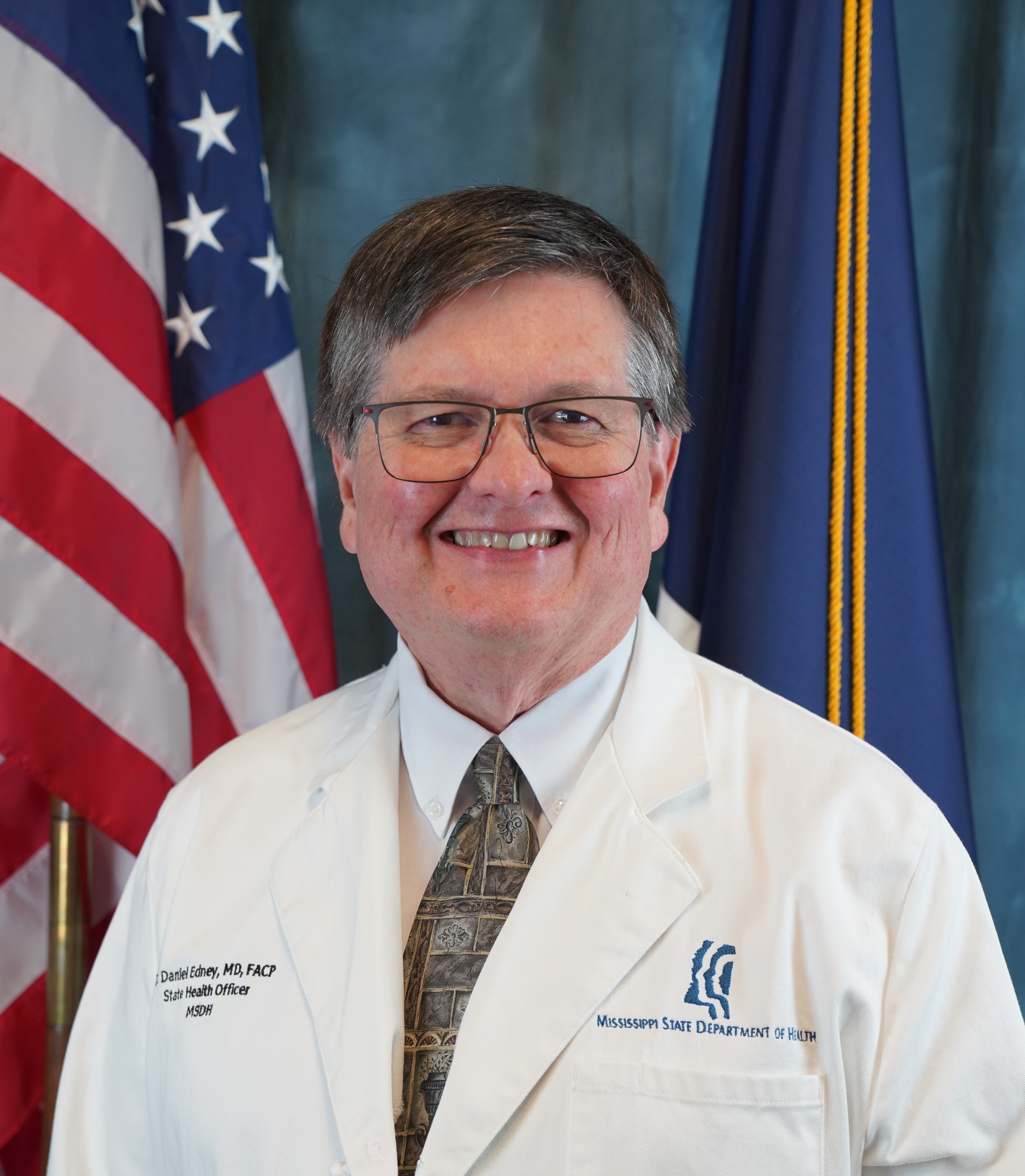
ASTHO's new President and Mississippi State Health Officer Daniel Edney shares how state and territorial health officials can address persistent health challenges and learn from one another. He highlights lessons learned in Mississippi: support for maternal and infant health and rural communities, and developing solutions driven by local needs.

 Spotify

 Apple Podcasts

 Amazon Music
Building trust in public health starts with transparency, innovation, and a commitment to improving lives. Daniel Edney, Mississippi State Health Officer and new ASTHO president, joins us to discuss how state and territorial health officials can strengthen relationships with their communities, address persistent health challenges, and learn from one another. Edney shares lessons from Mississippi’s efforts to improve maternal and infant health, expand support for rural communities, and develop solutions driven by local needs rather than funding priorities. He also reflects on a major public health achievement: Mississippi’s infant mortality rate declined in 2025 following the state’s declaration of a public health emergency. Edney explains how collaboration, strategic investments, and a renewed focus on the people public health serves can help rebuild trust and save lives.
Partner Spotlight: Q&A with Kate Menard on Levels of Maternal Care State Implementation | ASTHO
Public Health Performance Management Solutions Showcase
Funding & Collaboration Opportunities | ASTHO

JOHN SHEEHAN:
This is Public Health Review Morning Edition for Wednesday, October 21, 2026. I'm John Sheehan with news from the Association of State and Territorial Health Officials.
Building trust in public health starts with transparency, innovation, and a commitment to improving lives. Today, Mississippi Health Officer and new ASTHO President Dr. Daniel Edney joins us to discuss how state and territorial health officials can strengthen relationships with their communities, address persistent health challenges, and learn from one another. Edney shares lessons from Mississippi's efforts to improve maternal and infant health, expand support for rural communities, and develop solutions driven by local needs rather than funding priorities.
Dr. Daniel Edney, welcome to the show.
DANIEL EDNEY:
Great, thank you. Glad to be with you.
SHEEHAN:
So, Dr. Edney, you've spent more than three decades practicing medicine, and you've served as Mississippi's state health officer since 2022. How has your experience as a clinician shaped how you approach public health leadership?
EDNEY:
Well, you know, I have, you know, firsthand knowledge of what poor outcomes do to individuals and families for the things that are killing the majority of Mississippians, and really, it was my 30-plus years of clinical practice in primary care, and knowing that I had worked so hard my whole career trying to make things better in the part of Mississippi where I live and worked, and yet at the end of 30 years, it was no better, and in some ways it was worse. And to have the opportunity to come as the state health officer and work on those issues at a population level is really what drove me to accept the appointment because I knew doing it, you know, one patient at a time was not going to get us where we needed to be. That I had to take on a new patient. That was the population of Mississippi. So I exchanged about 5000 private patients for 2.9 million public patients. The work is just as passionate for me at this level as it ever was in private practice. So I have real-world experience to know exactly what people are up against trying to receive medical care, to receive access, you know, just to the basics of things that will improve our population health outcomes in Mississippi, and to have the opportunity to pull levers that I just never could touch before to impact things at a population level was just very exciting to me.
SHEEHAN:
You said that building trust in public health will be a priority during your ASTHO presidency. What does building trust look like to you, and what can health officials do to strengthen those relationships with their communities?
EDNEY:
I believe it's all on us at the state and territorial level to reestablish trust in public health. And what we have done in Mississippi successfully is just to be transparent, to be honest, to let everybody know what we know and what we don't know, and to let people know what resources we have and what we don't have, and then to be a good steward of the resources that have been entrusted with us, and then show you know what we're doing and why we're doing it. So we're kind of out of the old mold of the same old, same old, getting a federal grant and operationalizing it to the last four years, really setting the public health agenda for Mississippi at the Mississippi State Department of Health, and then acquiring the funding that we need for that agenda, rather than allowing federal funding or any other funding to determine what our agenda is, and letting the people of Mississippi see that and know that, and that has proven to establish a lot of trust for us post-pandemic. You know, among our elected officials, as the Mississippi legislature, and with the general public, you know we are and remain a trusted voice when it comes to the issues of public health in Mississippi, and we're going to have to do that nationwide through all the states and territories. And I, I just know if the people of Pennsylvania have trust in Dr. Deb Bogen, and they have trust in me, and they have trust in our colleagues around the nation. Then the trust in public health will return. I just think we're at a point now that the states have to lead in this effort, and it's been very intriguing to me that for the last two years, the states have been the ones to provide stability in terms of, you know, the issues with public health trust. I mean, we in Mississippi we've had to provide our own stability in funding, and we plan to do that, you know, as we move forward, but, as I and all my colleagues really work on the issue of being worthy of the public's trust, you know we'll get it, and I think we're much more likely to get it than just about anybody else. People still love and trust their local doctors, and I believe they're more likely to love and trust us at the state and territorial level.
SHEEHAN:
Maternal and infant health and rural health are two areas that you've identified as priorities in your presidency. What have you learned in your work in Mississippi that you think could help other states?
EDNEY:
Yeah, it's a great question. I think the most important lesson for us is, you know, stop doing the same old thing that's keeping us right where we are. And I've been preaching in Mississippi. Our system is designed perfectly to generate the outcomes that we have in Mississippi, and so we don't have hospitals and doctors and nurses that are sick or substandard; we have a system that is sick and substandard that we've been working on the last four years, and is already beginning to generate positive results as we see our population health outcomes improving in Mississippi. So, you know, sometimes there is a significant advantage being at the back of the pack: you can see the pack, you can see how fast the pack's running and where they're running, and you can see other folks ahead of you tripping up, and see the obstacles they're running into before we get there, and we take advantage of that every chance we get in Mississippi. However, at some point you got to move up for the sake of your people, and that's where we are now. Our trajectory is upward in Mississippi with our population health outcomes, and just because you're at the back of the pack doesn't mean you can't be innovative, and we're being very innovative in Mississippi, in terms, especially in the maternal and infant health space, the potential system of care is a major legacy initiative that we have going on at the state Department of Health our saving the smallest campaign, and our attacking safe sleep deficiencies every way that we can with our crib distribution program, our CHW-driven home visitation program for high-risk moms and babies. I can go on and on for another hour about the initiatives, but these are all initiatives that we're generating ourselves, and then it's my job to get the funding for it. And so we are determining in Mississippi what it is that Mississippians need, so that moms and babies have a better chance and have improved outcomes, and how do we do that in a very, very rural state? And we do that by thinking outside the box, being willing to try new initiatives, but doing it strategically and making strategic investments using the evidence every chance we have, but there are a couple of areas that you'll see Mississippi moving into in the next six months that where we'll be generating the evidence, and other states are watching us and will be able to follow us as we demonstrate how strategic investments are paying off in states like Mississippi, so I think the biggest issue is don't be afraid to try something innovative.
SHEEHAN:
You've emphasized the importance of states and territories learning from one another, especially during this uncertainty for public health systems. What do you think State Health Officials can learn from each other right now?
EDNEY:
Oh wow, that is such an important question, and it's something that we do in Regions Four and Six. The State Health Officers in our two regions are very close and work very closely together. You know, we had our regular weekly call this morning where we were discussing common challenges and oftentimes being able to give one another a heads-up on, you know, what we're encountering. You know, my buddy Colonel Reed in Oklahoma giving me notice of some challenges that he's having that we haven't had yet makes my job easier, and I want to do that for him and my other colleagues; working with Dr. Kathleen Toomey in Georgia, and respecting the work they're doing with their home visitation program and learning from them and adjusting our home visitation program in ways that they've shown will demonstrate better results. You know, if we stay in our state and territorial silos, we will be less effective. And so we're, you know, within our own agency, we've been dismantling silos within our state with other partners. We've been trying to dismantle silos, especially in state government, but having the opportunity to dismantle. The silos between the states, I think, are very effective, and especially states in Region Four that are very much like Mississippi. Their work is so instructive to what we're trying to do, and I'm so grateful. It was that they're willing to share their expertise with us. And something I can tell you is absolutely my primary responsibility is for the health and safety of Mississippians. But I care a lot about the health and safety of Arkansans and Tennesseans and Alabamians as well, because we have so many commonalities. And what's good for Tennessee is usually good for Mississippi and vice versa, so us working together just makes so much sense. And unfortunately, many times our funding streams really get in the way of that or discourage that. And I'm just proud that ASHTO helps us work together, collaborate effectively among state partners, and facilitates in every way that they can to make our jobs easier. And I'm truly grateful for that.
SHEEHAN:
And as you begin your ASTHO presidency, what do you hope to accomplish, and what do you hope people across the country will better understand about the work of public health?
EDNEY:
I think my main message for myself, my colleagues, definitely, you know, my team within the Mississippi State Department of Health is just, yeah, it's going to be all right. It's going to be all right. Let's keep our focus where it needs to be, and for us in Mississippi, it is to protect and advance the health, well-being, and safety of everyone in Mississippi, and I mean with no exceptions. As long as we all do that, and as long as ASTHO does that, then it's going to be all right. And it may today may be tough, tomorrow may be tougher, but I know that this too shall pass the challenges that are unique to us right now in public health- and I also know that we're up to the challenge. You know, I have no doubt whatsoever that my colleagues around the country are more than up to the task of reestablishing trust in public health and serving our jurisdictions with excellence and expertise, and you know, just showing the world that we can make a difference. That public health saves lives. Public health matters, and that we're the best examples of why that why that is true.
SHEEHAN:
Dr. Daniel Edney is the Mississippi State Health Officer and the new president of ASTHO.
ASTHO's Public Health Performance Management Solutions Showcase offers public health professionals an opportunity to explore solutions that can strengthen and support their agency's performance management efforts. Participants will hear from vendors and public health agencies about how different platforms and systems are being used in real-world settings, while gaining insights into key considerations for selecting and implementing a solution. The showcase is designed to help participants identify tools and approaches that align with their agency's priorities, capacity, and infrastructure needs. Register at the link in the show notes.
ASTHO is accepting applications for the 2027 Falls Prevention Virtual Community of Practice. This cohort-based learning experience will provide a platform for participating teams to exchange insights, develop action plans, refine implementation approaches, and strengthen planning for expanding falls prevention through community clinical linkages. CoP participants will engage in a series of virtual sessions to learn from fellow teams and experts, and receive technical assistance to implement STEADI-based strategies for preventing falls among older adults. Learn more at the link in the show notes.
This has been Public Health Review Morning Edition. I'm John Sheehan for the Association of State and Territorial Health Officials.